Product Marketing Manager
I build GTM engines that turn positioning into pipeline|
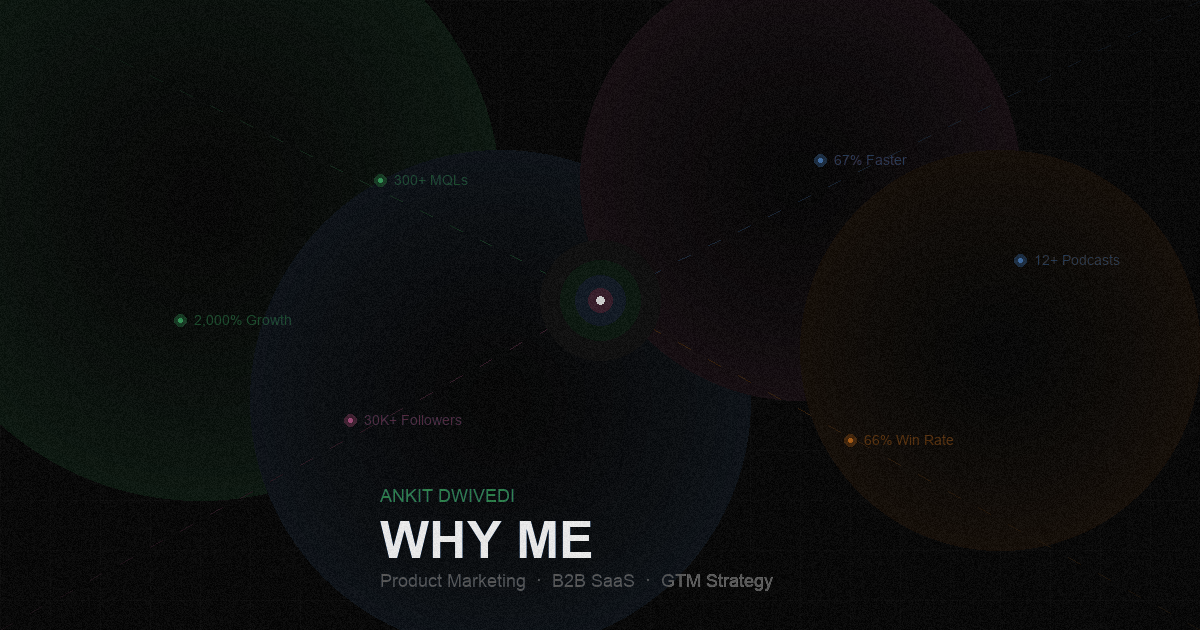
Seven years in B2B SaaS. Built go-to-market from zero, compressed enterprise sales cycles by 67%, and grew an unknown startup into a recognized industry voice — selling to the most risk-averse buyers in India: government and utility procurement.
Operating principle
AI compresses the distance between insight and action. I use it to eliminate the mechanical work — research synthesis, first drafts, pattern detection — so I can spend more time on the things AI can't do: reading a room, making a positioning bet, earning trust from a skeptical buyer.
The PMM who uses AI well isn't faster at the same work. They do different, better work.
Every number below traces back to positioning work — not campaigns, not tactics. The messaging architecture, buyer journey mapping, and competitive framing were the operating system that everything else ran on.
GTM Engine from Zero
First marketing hire. No brand, no pipeline, no inbound. Built everything from positioning to demand gen in a market where the default decision is no decision.
Sales Cycle: 9 → 3 Months
Deals stalled because champions couldn't build internal consensus. Mapped friction points, built persona-specific enablement kits, armed champions to sell when we weren't in the room.
Zero to Industry Voice
Built founder-led thought leadership that became the most effective sales enablement asset — more impactful than battle cards or ROI calculators — because it addressed the most fundamental blocker: trust.
AI is a thinking and research layer — not a replacement for strategic judgment. I use it to compress the mechanical work so I can spend more time on the judgment calls that actually move the business.
AI handles
- Research synthesis across 50+ pages
- First drafts from structured briefs
- Pattern detection across call transcripts
- Competitive data processing
- Content distribution automation
I handle
- Positioning bets and strategic judgment
- Stakeholder politics and buy-in
- Customer conversations and empathy
- Final voice, tone, and messaging approval
- Ethical and legal accountability
Generative Engine Optimization is about making your content the one that AI search engines — Perplexity, ChatGPT, Google AI Overviews — choose to cite when they generate answers. Few PMMs in India can speak to this practically. I implement it.
Structured Data & Schema
Person, Article, FAQ, and Organization schema markup that makes content unambiguous to AI systems. This site runs all four.
Entity-Based Optimization
Content structured around entities (people, products, concepts) rather than keywords. Consistent brand-category association across all surfaces.
Citation-Worthy Formatting
Self-contained paragraphs with specific data points. Content with statistics has up to 40% higher visibility in AI-generated responses.
Content-to-Pipeline Attribution
Connecting AI search visibility to actual pipeline outcomes. Not just "are we ranking" but "is AI sending us qualified buyers."
This site's Person schema LIVE
{
  "@type": "Person",
  "name": "Ankit Dwivedi",
  "jobTitle": "Product Marketing Manager",
  "knowsAbout": [
    "Product Marketing", "B2B SaaS",
    "Go-to-Market Strategy", "Positioning",
    "Competitive Intelligence",
    "Champion Enablement"
  ]
}
GEO doesn't replace SEO — it builds on top of it. But GEO adds an optimization layer specifically for how LLMs select, evaluate, and cite sources. This page is GEO-optimized.
I sold B2B SaaS to Indian government organizations and utility companies — arguably the most risk-averse buyers in the country. Procurement committees of 3-5 stakeholders. Nine-month sales cycles. A default decision of "do nothing." And I still compressed the cycle by 67%.
If your ICP is enterprise, if your sales cycle is long, if your buyers are skeptical — I've been in a harder room and built the playbook that works.
April Dunford Positioning
Adapted for markets where the real alternative is "do nothing," not a competitor product.
Buying Committee Mapping
Persona-level messaging architecture for multi-stakeholder procurement, not generic buyer personas.
Asymmetric Positioning
Competing on dimensions where startup advantages are structural. Turning youth into an advantage.
Champion Enablement
Designing content for internal advocates to use with their own buying committee, not for website visitors.
Credibility Engineering
Building trust through genuine expertise and utility, not self-promotion. The content that sells best never mentions the product.
Content-Pipeline Attribution
Connecting brand-building activities to measurable pipeline outcomes. Proving ROI on thought leadership.
Let's talk.
Looking for a PMM who builds engines, not just campaigns.
This portfolio was built, written, and optimized with AI assistance — Claude for content and code, Pillow for generated graphics, Ghost Admin API for automated publishing. The strategic decisions, positioning choices, and judgment calls are mine. See the full workflow.